Chapter 06 · 1600 – 1155 BCE
Middle Babylonian
The Kassite kings, international diplomacy.
~1300 BCE · Reconstructed composite — see ORACC entry for manuscript witnesses
Eriba-Adad I 1
“(1) [Erība-Ada]d (I), [vice-regent of the god Aššu]r, [son of Ašš]ur-bēl-nišēšu, (who was) also [vice-regent of the god Ašš]ur. [Ašš]ur-bēl-nišēšu (was) [the son of Ašš]ur-nārārī (II), [vice-regent of the god A]ššur; Aššur-nārārī (II) (was) [the son of Ašš]ur-rabi (I), [vice-regent of the god Aššu]r, (r 1') [Moreover, I deposited] my clay cone (there). (r 2') [(When) a future ru]ler [builds that …] when it becomes dilapidated, the gods Aššur [and Adad will (then) listen to] his [prayers. Moreover, may he retur]n my [clay co]ne [to its place].”
Source: Royal Inscriptions of Assyria online (RIAo), Munich Open-access Cuneiform Corpus Initiative (MOCCI), Ludwig-Maximilians-Universität München; in association with the RINAP Project, University of Pennsylvania. https://oracc.museum.upenn.edu/riao/Q005717/
Read the full tablet entry~1300 BCE · Reconstructed composite — see ORACC entry for manuscript witnesses
Eriba-Adad I 2
“(1) Erība-Adad (I), appointee of the god Enlil, vice-regent of the god Aššur, son of Aššur-bēl-nišēšu, [vice-regent of] the god Aššur.”
Source: Royal Inscriptions of Assyria online (RIAo), Munich Open-access Cuneiform Corpus Initiative (MOCCI), Ludwig-Maximilians-Universität München; in association with the RINAP Project, University of Pennsylvania. https://oracc.museum.upenn.edu/riao/Q005718/
Read the full tablet entry~1300 BCE · IM — (cast: SM 1999.02.012) — National Museum of Iraq, Baghdad, Iraq; Harvard Museum of the Ancient Near East, Harvard University, Cambridge, Massachusetts, USA
HSS 14, 028
In plain English
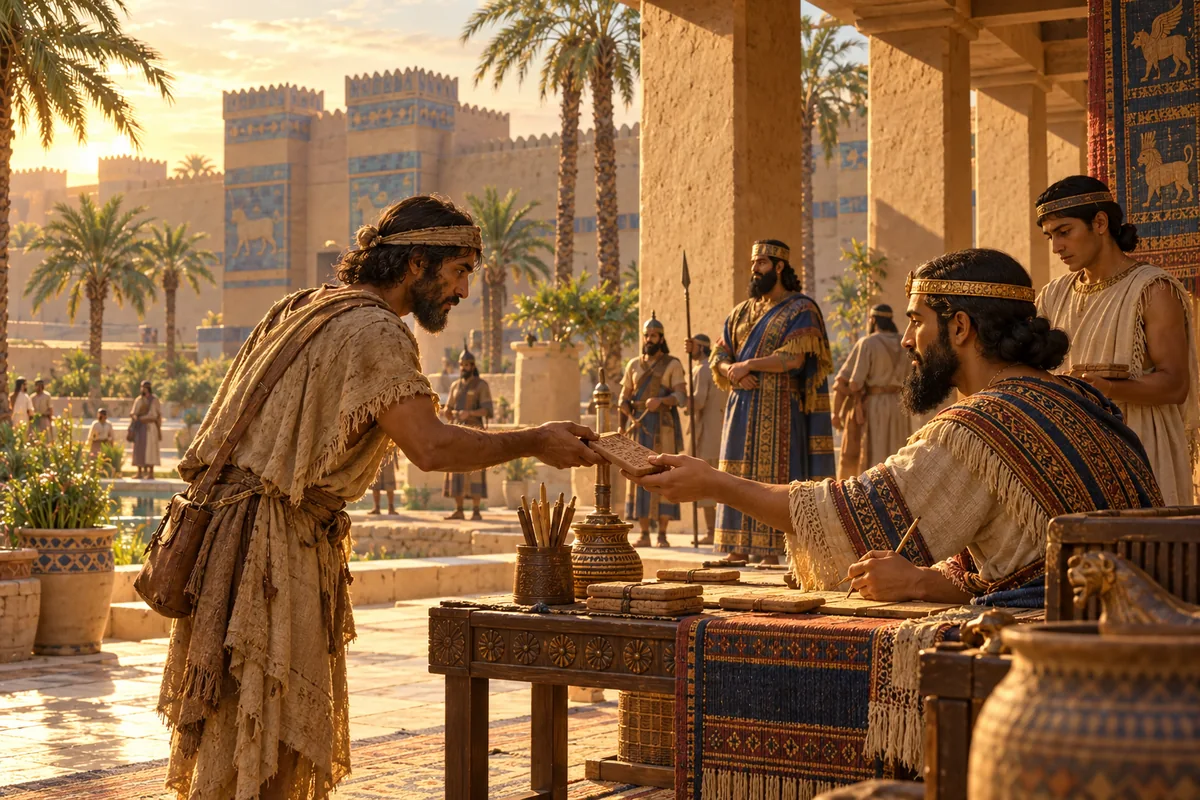
Message for Meštu, from Arrumti: Please hand over all the honey you made today, plus the one jar of oil that's sitting in the outer room by the entrance. Give it to my people so they can bring everything to me. That's the whole letter — a quick supply order, complete in ten short lines.
AI-generated reading paraphrase; compare with the translation below.
“To Meštu speak: thus (says) Arrumti: All the honey that you made today, and the 1 dallu-jar of oil that is placed in the outer room — give (them), and let them bring (them) to me.”
Source: engine:claude-fable-5 (2026-07-12/v7-evolved) · claude-fable-5 · medium confidence
Read the full tablet entry~1300 BCE · Reconstructed composite — see ORACC entry for manuscript witnesses
Puzur-Aššur III 1
“(1) Puzur-Aššur (III), vice-regent of the god Aššur, son of Aššur-nārā[rī] (I), vice-regent of the god Ašš[ur]. (5) For his life and the well-being of his city, (when) the wall of the Step Gate became dilapidated, he renovated (it). Moreover, I deposited my clay cone. (11) (When) a future ruler builds that wall when it becomes dilapidated, the gods Aššur and Adad will (then) listen to his prayers. [May he retur]n my clay cone to its place.”
Source: Royal Inscriptions of Assyria online (RIAo), Munich Open-access Cuneiform Corpus Initiative (MOCCI), Ludwig-Maximilians-Universität München; in association with the RINAP Project, University of Pennsylvania. https://oracc.museum.upenn.edu/riao/Q005696/
Read the full tablet entry~1300 BCE · Reconstructed composite — see ORACC entry for manuscript witnesses
Puzur-Aššur III 1001
In plain English
Only scraps of this text survive, but its shape is clear. It names the god Aššur and speaks of a structure — one his forefathers had built — that had fallen into ruin. For the sake of his own life and the safety of his city, the ruler rebuilt it and buried inscribed clay cones in the foundations to mark the deed. The closing lines address whoever rules later: when these walls crumble again, rebuild them, and the gods Aššur and Adad will hear your prayers — and put the clay cones back where you found them. The rest of the text is lost.
AI-generated reading paraphrase; compare with the translation below.
“(1) [... A]ššur [...] (2) [...] of his god [...] (3) [... which/when ...] became dilapidated, and (4) [for his life and] the well-being of [his] city (5) [...] his forefathers (6) [... I] deposited [my clay co]nes. (7) [... w]hen (8) [... th]ose [walls (?)] become dilapidated, (9) [(and he rebuilds them), the gods Aššur and] Adad (10) [will listen to his prayers]. (11) [May he re]tu[rn the clay cones to their place].”
Source: engine:claude-fable-5 (2026-07-12/v7-evolved) · claude-fable-5 · medium confidence
Read the full tablet entry~1300 BCE · Reconstructed composite — see ORACC entry for manuscript witnesses
Puzur-Aššur III 2
“(1) Puzur-Aššur (III), vice-regent of the god Aššur, son of Aššur-nārārī (I), (who was) also vice-regent of the god Aššur. (5) (As for) the šuḫūru-room of the temple of the Assyrian Ištar, which Ilu-šūma, (a) ruler (who came before me), had built and (which) Sargon (I), my ancestor, the son of Ikūnum, had restored, it had become dilapidated and I (re)built (it).”
Source: Royal Inscriptions of Assyria online (RIAo), Munich Open-access Cuneiform Corpus Initiative (MOCCI), Ludwig-Maximilians-Universität München; in association with the RINAP Project, University of Pennsylvania. https://oracc.museum.upenn.edu/riao/Q005697/
Read the full tablet entry~1300 BCE · Reconstructed composite — see ORACC entry for manuscript witnesses
Puzur-Aššur III 3
“(1) [Pu]zur-[Aššur (III), vice]-regent of the god Aššur, son of Aššur-nārā[rī (I), (who was) also vice]-regent of the god Aššur, (5) [built ...] the gate [... for his life] and the well-being [of his city].”
Source: Royal Inscriptions of Assyria online (RIAo), Munich Open-access Cuneiform Corpus Initiative (MOCCI), Ludwig-Maximilians-Universität München; in association with the RINAP Project, University of Pennsylvania. https://oracc.museum.upenn.edu/riao/Q005698/
Read the full tablet entry~1300 BCE · Reconstructed composite — see ORACC entry for manuscript witnesses
Puzur-Aššur III 4
“(1) [Puz]ur-Aššur (III), [..., vice-regent of] the god Aššur, [...] ... [...]”
Source: Royal Inscriptions of Assyria online (RIAo), Munich Open-access Cuneiform Corpus Initiative (MOCCI), Ludwig-Maximilians-Universität München; in association with the RINAP Project, University of Pennsylvania. https://oracc.museum.upenn.edu/riao/Q005699/
Read the full tablet entry