Chapter 07 · 911 – 609 BCE
Neo-Assyrian
Empire, library, terror, scholarship.
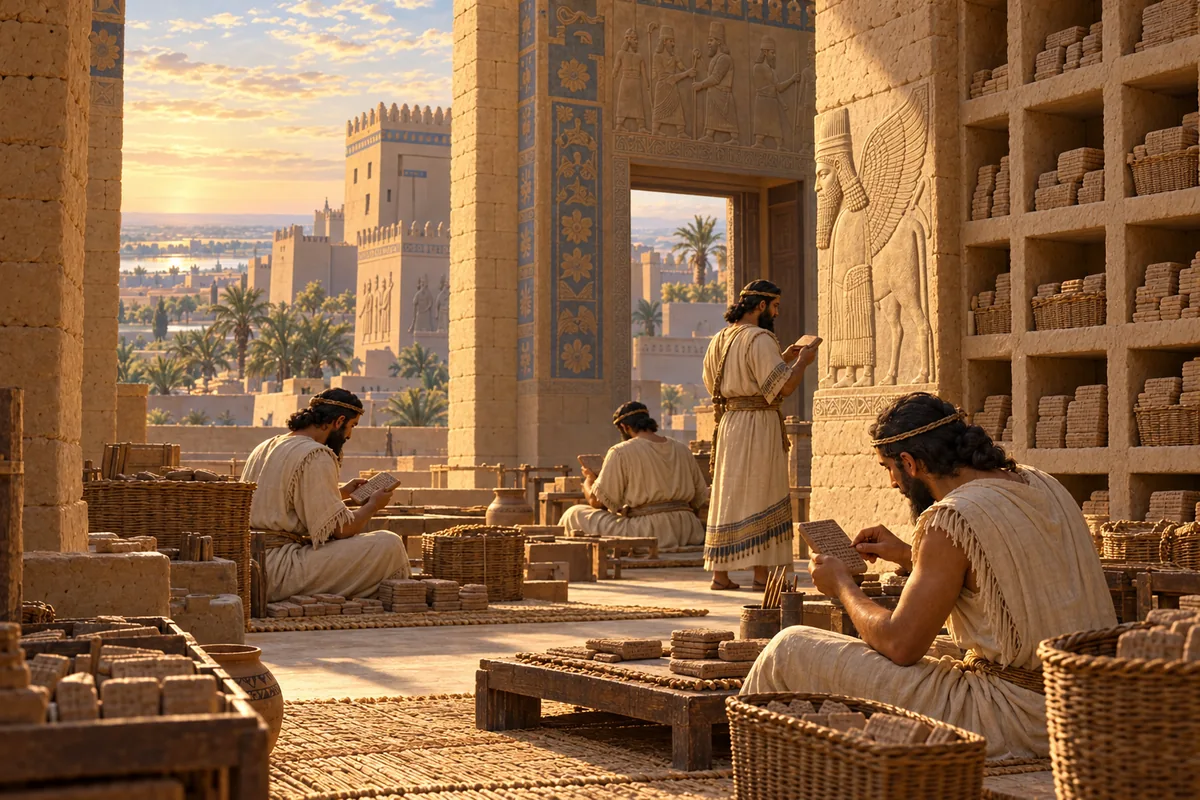
~850 BCE · Reconstructed composite — see ORACC entry for manuscript witnesses
Shalmaneser III 070
“(1) Payment of Sangara of the city Carchemish.”
Source: Royal Inscriptions of Assyria online (RIAo), Munich Open-access Cuneiform Corpus Initiative (MOCCI), Ludwig-Maximilians-Universität München; in association with the RINAP Project, University of Pennsylvania. https://oracc.museum.upenn.edu/riao/Q004675/
Read the full tablet entry~850 BCE · Reconstructed composite — see ORACC entry for manuscript witnesses
Shalmaneser III 071
“(1) I captured a city of Arrāmu of the land Urarṭu.”
Source: Royal Inscriptions of Assyria online (RIAo), Munich Open-access Cuneiform Corpus Initiative (MOCCI), Ludwig-Maximilians-Universität München; in association with the RINAP Project, University of Pennsylvania. https://oracc.museum.upenn.edu/riao/Q004676/
Read the full tablet entry~850 BCE · Reconstructed composite — see ORACC entry for manuscript witnesses
Shalmaneser III 072
“(1) Payment of the people of the land Gilzānu.”
Source: Royal Inscriptions of Assyria online (RIAo), Munich Open-access Cuneiform Corpus Initiative (MOCCI), Ludwig-Maximilians-Universität München; in association with the RINAP Project, University of Pennsylvania. https://oracc.museum.upenn.edu/riao/Q004677/
Read the full tablet entry~850 BCE · Reconstructed composite — see ORACC entry for manuscript witnesses
Shalmaneser III 073
“(1) I conquered the city Uppumu, which belonged to Anḫitti of the land Šubria.”
Source: Royal Inscriptions of Assyria online (RIAo), Munich Open-access Cuneiform Corpus Initiative (MOCCI), Ludwig-Maximilians-Universität München; in association with the RINAP Project, University of Pennsylvania. https://oracc.museum.upenn.edu/riao/Q004678/
Read the full tablet entry~850 BCE · Reconstructed composite — see ORACC entry for manuscript witnesses
Shalmaneser III 075
“(1) I conquered the city Adâ, which belonged to Irḫulena (Urḫilena) of the land Hamath.”
Source: Royal Inscriptions of Assyria online (RIAo), Munich Open-access Cuneiform Corpus Initiative (MOCCI), Ludwig-Maximilians-Universität München; in association with the RINAP Project, University of Pennsylvania. https://oracc.museum.upenn.edu/riao/Q004680/
Read the full tablet entry~850 BCE · Reconstructed composite — see ORACC entry for manuscript witnesses
Shalmaneser III 076
“(1) I captured the city Qarqar, which belonged to Irḫulena (Urḫilena) of the land Hamath.”
Source: Royal Inscriptions of Assyria online (RIAo), Munich Open-access Cuneiform Corpus Initiative (MOCCI), Ludwig-Maximilians-Universität München; in association with the RINAP Project, University of Pennsylvania. https://oracc.museum.upenn.edu/riao/Q004681/
Read the full tablet entry~850 BCE · Reconstructed composite — see ORACC entry for manuscript witnesses
Shalmaneser III 077
“(1) I captured (and) burned with fire the city Kulisi, the royal city of Gizuata.”
Source: Royal Inscriptions of Assyria online (RIAo), Munich Open-access Cuneiform Corpus Initiative (MOCCI), Ludwig-Maximilians-Universität München; in association with the RINAP Project, University of Pennsylvania. https://oracc.museum.upenn.edu/riao/Q004682/
Read the full tablet entry~850 BCE · Reconstructed composite — see ORACC entry for manuscript witnesses
Shalmaneser III 078
“(1) I entered (the region of) the mouth of the river, made sacrifices to the gods, (and) erected my royal statue.”
Source: Royal Inscriptions of Assyria online (RIAo), Munich Open-access Cuneiform Corpus Initiative (MOCCI), Ludwig-Maximilians-Universität München; in association with the RINAP Project, University of Pennsylvania. https://oracc.museum.upenn.edu/riao/Q004683/
Read the full tablet entry