Chapter 07 · 911 – 609 BCE
Neo-Assyrian
Empire, library, terror, scholarship.
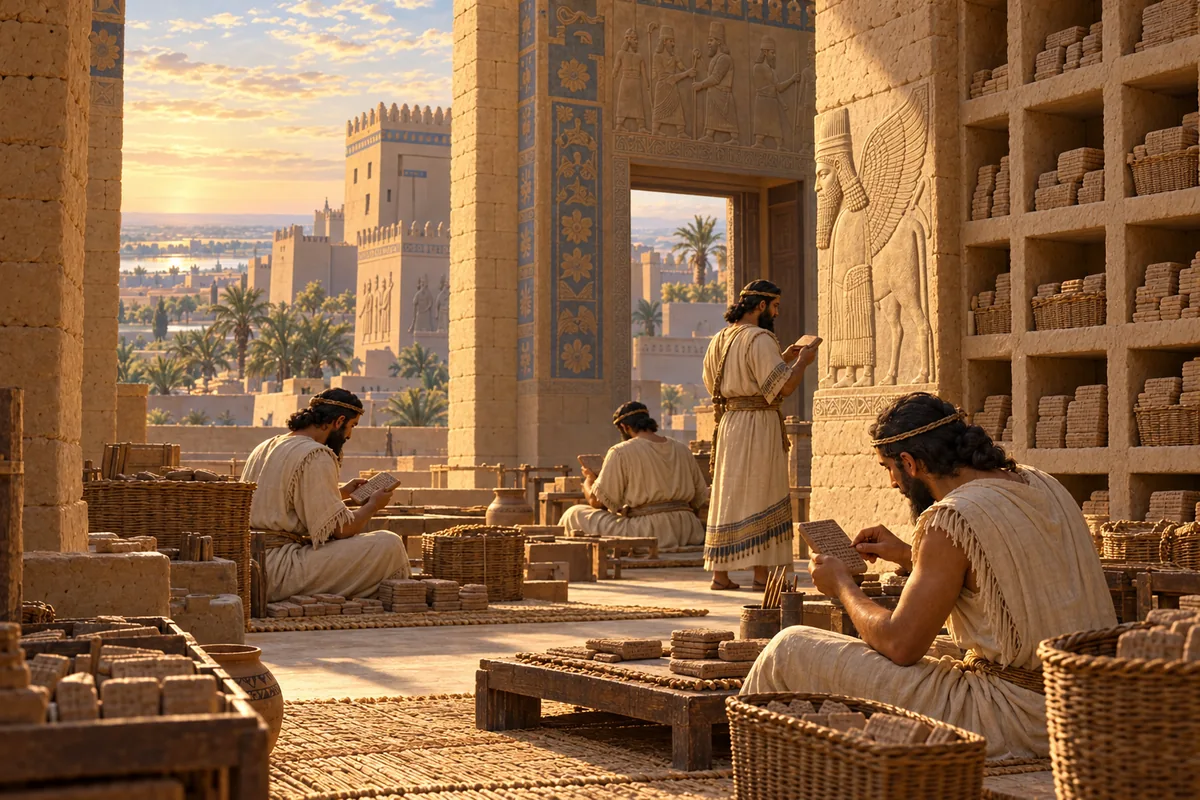
~850 BCE · Reconstructed composite — see ORACC entry for manuscript witnesses
Shalmaneser III 011
“(1') [... the god Šamaš, the judge of heaven] and netherworld, the commander [of all]; the god Nergal, the perfect one, the king of battle; [the god Nusku], the bearer of the holy scepter, the circumspect god; (and) the goddess Mullissu, the spouse of the god Enlil, [the mother of] the great [gods]; the great gods, who [decree destinies] (and) who aggrandize my kingship. (7'b) [Shalmaneser (III)], king of all of the people, ruler, vice-regent of (the god) Aššur, [strong king, king of all] four quarters (of the world), sun(god) of [all of the people, ruler of] all of the lands; son of…”
Source: Royal Inscriptions of Assyria online (RIAo), Munich Open-access Cuneiform Corpus Initiative (MOCCI), Ludwig-Maximilians-Universität München; in association with the RINAP Project, University of Pennsylvania. https://oracc.museum.upenn.edu/riao/Q004616/
Read the full tablet entry~850 BCE · Reconstructed composite — see ORACC entry for manuscript witnesses
Shalmaneser III 012
“(1) For the god Adad, the canal inspector of heaven (and) netherworld, the lofty one, the lord of all, the almighty among the gods, the awesome (god) whose strength is unrivalled, the who bears a holy whip that chums up the seas, the who controls all of the winds, the who provides abundant water, the who brings down rain (and) makes lightning flash, the one who creates vegetation, at whose shout the mountains shake (and) the seas are churned up, the compassionate god whose sympathetic concern is life, the one who dwells in the city Kurbail — the holy shrine — the great lord, his lord: (9)…”
Source: Royal Inscriptions of Assyria online (RIAo), Munich Open-access Cuneiform Corpus Initiative (MOCCI), Ludwig-Maximilians-Universität München; in association with the RINAP Project, University of Pennsylvania. https://oracc.museum.upenn.edu/riao/Q004617/
Read the full tablet entry~850 BCE · Reconstructed composite — see ORACC entry for manuscript witnesses
Shalmaneser III 013
“(1') [I captured] the cities of Arrā[mu of the land Urarṭu, as far as the source] of the Tigris River (and) as far as the source [of the Euphrates River]. (2'b) [In my sixteenth regnal year, I crossed Mount Kullar (and)] conquered the lands Mannea (Munna), Allabr[ia, Parsua, (Bit-)Abdadāni, (Bīt-)Ḫamban, Namri], (and) Tupliyaš (Tugliyaš). (4'b) [In my seventeenth regnal year, I crossed the Euphrates River (and) received the payment] of the kings of the land Ḫatti. [I ascended Mount Amanus], cut down [beams of] cedar, [(and) brought (them)] to my city, [Aššur. On my return march] from Mount…”
Source: Royal Inscriptions of Assyria online (RIAo), Munich Open-access Cuneiform Corpus Initiative (MOCCI), Ludwig-Maximilians-Universität München; in association with the RINAP Project, University of Pennsylvania. https://oracc.museum.upenn.edu/riao/Q004618/
Read the full tablet entry~850 BCE · Reconstructed composite — see ORACC entry for manuscript witnesses
Shalmaneser III 014
“(1) The god Aššur, the great lord, the king of all of the great gods; the god Anu, the king of the Igīgū and Anunnakū gods: the lord of the lands, the god Enlil, the exalted one, the father of the gods, the creator of (5) all; the god Ea, the king of the apsû, the one who decrees destinies; the god [Sîn, the wise one], the king of the lunar disk, the lofty luminary; the god Adad, the exceptionally strong one, the lord of abundance; the god Šamaš, the judge of heaven and netherworld, the commander of all; [the god Mardu]k, the sage of the gods, the lord of omens; the god Ninurta, the warrior…”
Source: Royal Inscriptions of Assyria online (RIAo), Munich Open-access Cuneiform Corpus Initiative (MOCCI), Ludwig-Maximilians-Universität München; in association with the RINAP Project, University of Pennsylvania. https://oracc.museum.upenn.edu/riao/Q004619/
Read the full tablet entry~850 BCE · Reconstructed composite — see ORACC entry for manuscript witnesses
Shalmaneser III 016
“(1) Shalmaneser (III), strong (and) wise ruler, chosen [of the gods Enlil and Ninurta], ..., expert, [...], faithful shepherd, king of the four (quarters of the world), worshipper of the [great] gods, [...]; son of Ashurnasirpal (II), exalted priest, who [always achieved] the defeat of those insubmissive [to him], pure offspring of Tukultī-Ninurta (II), who slew his enemies [and annihilated (them) like a flood]: (6) At the beginning of my reign, after [I sat on] the throne of my royal majesty [in a grandiose manner], I mustered [my chariots] (and) troops. I entered the pass of the land Simesi…”
Source: Royal Inscriptions of Assyria online (RIAo), Munich Open-access Cuneiform Corpus Initiative (MOCCI), Ludwig-Maximilians-Universität München; in association with the RINAP Project, University of Pennsylvania. https://oracc.museum.upenn.edu/riao/Q004621/
Read the full tablet entry~850 BCE · Reconstructed composite — see ORACC entry for manuscript witnesses
Shalmaneser III 017
“(1) [The god Aššur, the great lord, the lord of] the lands, the shepherd of all of the rulers; (2) [the goddess Ištar, ...], the lofty one , lady of Nineveh; (3) [the god Šamaš ...] ... justice; (4) [Shalmaneser (III) ...] the world, (5) [...] ... [...] ... (6) The gods Bēl (Marduk) (and) Anu entrusted to you the distant [mountains]. (7) The obstinate slave of Bīt-Adini (and) his allies, [they (the gods) defeated], (8) The city Tīl-Barsip, the fortified town, they (the gods) burned with fire, (9) The kings of the land Ḫatti, they (the gods) destroyed their abodes. (10) He (Shalmaneser) spoke…”
Source: Royal Inscriptions of Assyria online (RIAo), Munich Open-access Cuneiform Corpus Initiative (MOCCI), Ludwig-Maximilians-Universität München; in association with the RINAP Project, University of Pennsylvania. https://oracc.museum.upenn.edu/riao/Q004622/
Read the full tablet entry~850 BCE · Reconstructed composite — see ORACC entry for manuscript witnesses
Shalmaneser III 018
“(1') No translation warranted. (5') [I marched] to the land Akkad [... (and) surrounded] the city Gann[anāte ...] (Marduk-bēl)-uṣāti [...] with him ... [...] I killed/defeated (Marduk-bēl)-uṣāti, [together with the traitorous troops] who were with him. [I marched to Babylon] and Borsippa [and made sacrifices] before my gods. [I went down to Chaldea and approached] the city Baqānu, a fortress of A[dīnu] of (Bīt-)Dakkūri (lit. “son of Dakkūru”). I imposed upon him [...] ... (15'b) [At that time], (as for) the temple of (the god) Aššur, my lord, [its] walls [had become dilapidated]. In their…”
Source: Royal Inscriptions of Assyria online (RIAo), Munich Open-access Cuneiform Corpus Initiative (MOCCI), Ludwig-Maximilians-Universität München; in association with the RINAP Project, University of Pennsylvania. https://oracc.museum.upenn.edu/riao/Q004623/
Read the full tablet entry~850 BCE · Reconstructed composite — see ORACC entry for manuscript witnesses
Shalmaneser III 019
“(1) For the god Ninurta, the strong (and) almighty one, the exalted one, the foremost one among the gods, the splendid (and) perfect warrior whose attack in battle is unequalled, [the who resides in] the city Kalḫu, the great lord, [my] lord: (6b) Shalmaneser (III), vice-regent of (the god) Aššur, [son of Ashurnasir]pal (II), vice-regent of (the god) Aššur, son of Tukul[tī-Ninurta (II) (who was) also vice-regent of (the god) Aššur]. (8b) No translation possible. (r 1) [I] brought about their defeat (and) deprived them of their chariots (and) cavalry. Upon my return march, I ascended Mount Amanus. [...] ... [...] ... [...] ... [...] ...”
Source: Royal Inscriptions of Assyria online (RIAo), Munich Open-access Cuneiform Corpus Initiative (MOCCI), Ludwig-Maximilians-Universität München; in association with the RINAP Project, University of Pennsylvania. https://oracc.museum.upenn.edu/riao/Q004624/
Read the full tablet entry