Chapter 07 · 911 – 609 BCE
Neo-Assyrian
Empire, library, terror, scholarship.
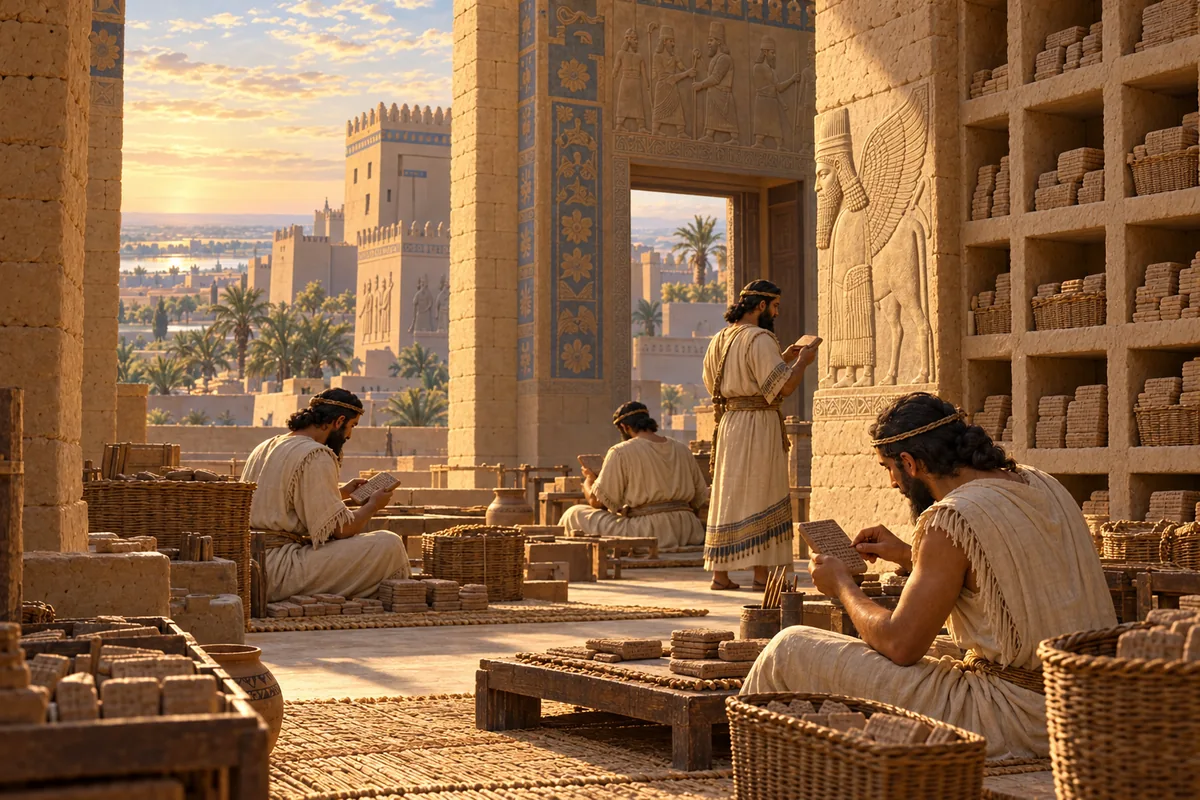
~875 BCE · Reconstructed composite — see ORACC entry for manuscript witnesses
Ashurnasirpal II 124
“(1) Palace of Ashurnasirpal (II), great king, strong king, king of the world, king of Assyria, son of Tukultī-Ninurta (II), great king, strong king, king of the world, king of Assyria, son of Adad-nārārī (II), (who was) also great king, strong king, king of the world, (and) king of Assyria.”
Source: Royal Inscriptions of Assyria online (RIAo), Munich Open-access Cuneiform Corpus Initiative (MOCCI), Ludwig-Maximilians-Universität München; in association with the RINAP Project, University of Pennsylvania. https://oracc.museum.upenn.edu/riao/Q004578/
Read the full tablet entry~875 BCE · Reconstructed composite — see ORACC entry for manuscript witnesses
Ashurnasirpal II 125
Anchors Ashurnasirpal II's reign in a three-generation patriline — Adad-nārārī II, Tukultī-Ninurta II, Ashurnasirpal II — asserting dynastic continuity as ideological foundation for his aggressive territorial expansion.
“(1) Palace of Ashurnasirpal (II), king of Assyria, son of Tukultī-Ninurta (II), king of Assyria, son of Adad-nārārī (II), (who was) also king of Assyria.”
Source: Royal Inscriptions of Assyria online (RIAo), Munich Open-access Cuneiform Corpus Initiative (MOCCI), Ludwig-Maximilians-Universität München; in association with the RINAP Project, University of Pennsylvania. https://oracc.museum.upenn.edu/riao/Q004579/
Read the full tablet entry~875 BCE · Reconstructed composite — see ORACC entry for manuscript witnesses
Ashurnasirpal II 126
Dedicatory inscription linking Ashurnasirpal II's three-generation Enlil-appointed lineage to the Ištar temple at Nineveh, documenting royal legitimation through divine office and cultic patronage in the early Neo-Assyrian period.
“(1) Ashurnasirpal (II), appointee of the god Enlil, vice-regent of (the god) Aššur, son of Tukultī-Ninurta (II), appointee of the god Enlil, vice-regent of (the god) Aššur, son of Adad-nārārī (II), (who was) also appointee of the god Enlil (and) vice-regent of (the god) Aššur: property of the temple of the goddess Ištar of Nineveh.”
Source: Royal Inscriptions of Assyria online (RIAo), Munich Open-access Cuneiform Corpus Initiative (MOCCI), Ludwig-Maximilians-Universität München; in association with the RINAP Project, University of Pennsylvania. https://oracc.museum.upenn.edu/riao/Q004580/
Read the full tablet entry~875 BCE · Reconstructed composite — see ORACC entry for manuscript witnesses
Ashurnasirpal II 127
Anchors Ashurnasirpal II's legitimacy in a three-generation chain of divine appointment — each king named vice-regent of Aššur — illustrating how Neo-Assyrian titulary encoded dynastic continuity as theological fact.
“(1) Ashurnasirpal (II), appointee of the god Enlil, vice-regent of (the god) Aššur, son of Tukultī-Ninurta (II), appointee of the god Enlil, vice-regent of (the god) Aššur, son of Adad-nārārī (II), appointee of the god Enlil, vice-regent of (the god) Aššur.”
Source: Royal Inscriptions of Assyria online (RIAo), Munich Open-access Cuneiform Corpus Initiative (MOCCI), Ludwig-Maximilians-Universität München; in association with the RINAP Project, University of Pennsylvania. https://oracc.museum.upenn.edu/riao/Q004581/
Read the full tablet entry~875 BCE · Reconstructed composite — see ORACC entry for manuscript witnesses
Ashurnasirpal II 128
“(1) Ashurnasirpal (II), king of Assyria, son of Tukultī-Ninurta (II), king of Assyria, son of Adad-nārārī (II), [((who was) also)] king of Assyria.”
Source: Royal Inscriptions of Assyria online (RIAo), Munich Open-access Cuneiform Corpus Initiative (MOCCI), Ludwig-Maximilians-Universität München; in association with the RINAP Project, University of Pennsylvania. https://oracc.museum.upenn.edu/riao/Q004582/
Read the full tablet entry~875 BCE · Reconstructed composite — see ORACC entry for manuscript witnesses
Ashurnasirpal II 129
A standard palace titulary of Ashurnasirpal II anchoring his legitimacy in paternal succession — one of the corpus of RIAo inscriptions (Q004583) documenting how Assyrian kings constructed royal identity in stone.
“(1) Palace of Ashurnasirpal (II), king of the world, king of Assyria, son of Tukultī-Ninurta (II), who was) also king of Assyria.”
Source: Royal Inscriptions of Assyria online (RIAo), Munich Open-access Cuneiform Corpus Initiative (MOCCI), Ludwig-Maximilians-Universität München; in association with the RINAP Project, University of Pennsylvania. https://oracc.museum.upenn.edu/riao/Q004583/
Read the full tablet entry~875 BCE · Reconstructed composite — see ORACC entry for manuscript witnesses
Ashurnasirpal II 130
Marks the palace contents of Ashurnasirpal II as sacred property of the god Ninurta, documenting the deliberate entanglement of royal and temple authority at the Assyrian court circa 875 BCE.
“(1) Palace of Ashurnasirpal (II), king of the world, king of Assyria, son of Tukultī-Ninurta (II), king of the world, king of Assyria, son of Adad-nārārī (II), (who was) also king of the world (and) king of Assyria: property of the temple of the god Ninurta.”
Source: Royal Inscriptions of Assyria online (RIAo), Munich Open-access Cuneiform Corpus Initiative (MOCCI), Ludwig-Maximilians-Universität München; in association with the RINAP Project, University of Pennsylvania. https://oracc.museum.upenn.edu/riao/Q004584/
Read the full tablet entry~875 BCE · Reconstructed composite — see ORACC entry for manuscript witnesses
Ashurnasirpal II 131
“(1) [Pa]lace of Ashurnasirpal (II), king of the world, [king of] Assyria, [son of] Tukultī-Ninurta (II), king of Assyria, son of Adad-nārārī (II), (who was) also king of Assyria: facing (brick) of the well of the temple of the Sebetti.”
Source: Royal Inscriptions of Assyria online (RIAo), Munich Open-access Cuneiform Corpus Initiative (MOCCI), Ludwig-Maximilians-Universität München; in association with the RINAP Project, University of Pennsylvania. https://oracc.museum.upenn.edu/riao/Q004585/
Read the full tablet entry