Chapter 07 · 911 – 609 BCE
Neo-Assyrian
Empire, library, terror, scholarship.
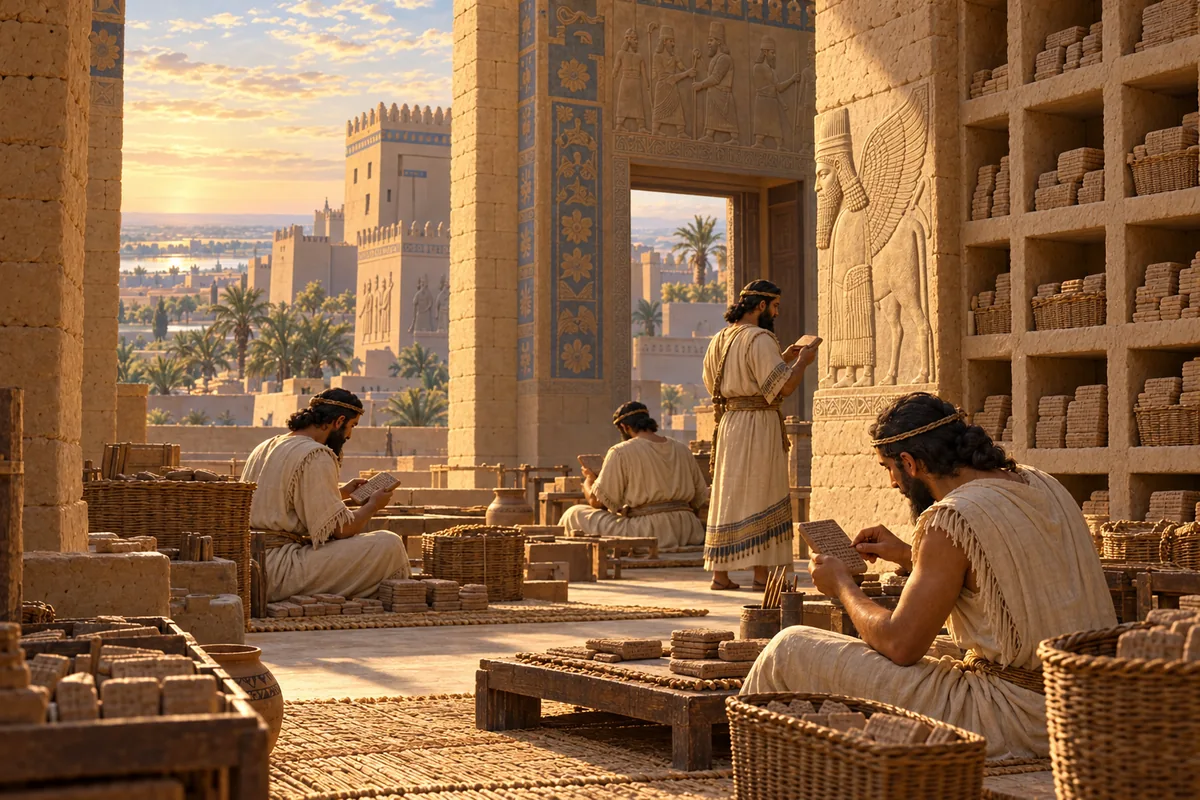
~875 BCE · Reconstructed composite — see ORACC entry for manuscript witnesses
Ashurnasirpal II 067
“(1) Ashurnasirpal (II), appointee of the god Enlil, vice-regent of (the god) Aššur, [son of Tukultī-Ni]nurta (II), appointee of the god Enlil, vice-regent of (the god) Aššur, son of [Adad-nārārī (II), appointee of the god En]lil, vice-regent of (the god) Aššur, (4) the one who conquered (everything) from [(...)] the slopes of the mountains of the Lullumê, the interior of the land Ḫabḫu, the land Zamua, (and) the land Ḫašmar, a[ll of them, to the land Amu]rru, Mount Amanus, and Mount Lebanon, as far as the Great Sea; [I counted (all of this territory) as within the boundar](ies) of m[y] land.…”
Source: Royal Inscriptions of Assyria online (RIAo), Munich Open-access Cuneiform Corpus Initiative (MOCCI), Ludwig-Maximilians-Universität München; in association with the RINAP Project, University of Pennsylvania. https://oracc.museum.upenn.edu/riao/Q004521/
Read the full tablet entry~875 BCE · Reconstructed composite — see ORACC entry for manuscript witnesses
Ashurnasirpal II 068
In plain English
Only scraps of this text survive, but they come from a familiar boast. The king is listing the territories he subdued: the lands of Nairi in the north, the land of Gilzānu, territory he conquered 'from the opposite bank' of a river, the land of Suḫu along the Euphrates 'as far as' some now-lost boundary, and the land of Zamua in the eastern mountains. In effect: 'I conquered everything from here to there' — the four compass points of Ashurnasirpal II's campaigns. The connecting phrases and everything before and after are lost to breakage.
AI-generated reading paraphrase; compare with the translation below.
“(obverse, fragmentary) [...] ... [...] [... the lands Na]iri, to [...] [... the land Gi]lzānu, from [...] [... he con]quered. From the opposite ba[nk of the river ...] [...] the land Suḫu as far as [...] [... the land] Zamu[a ...] (remainder broken)”
Source: engine:claude-fable-5 (2026-07-12/v7-evolved) · claude-fable-5 · medium confidence
Read the full tablet entry~875 BCE · Reconstructed composite — see ORACC entry for manuscript witnesses
Ashurnasirpal II 069
“(1) [...], king of the world, strong king, king of Assyria, [..., …, king of A]ssyria, son of Adad-nārārī (II), (who was) also king of the wo[rld, …]: (3) [..., which …, who had com]e before me, ha[d built, …] ... [...] ... [...]”
Source: Royal Inscriptions of Assyria online (RIAo), Munich Open-access Cuneiform Corpus Initiative (MOCCI), Ludwig-Maximilians-Universität München; in association with the RINAP Project, University of Pennsylvania. https://oracc.museum.upenn.edu/riao/Q004523/
Read the full tablet entry~875 BCE · Reconstructed composite — see ORACC entry for manuscript witnesses
Ashurnasirpal II 070
“(1) Palace of Ashurnasirpal (II), king of the world, king of Assyria, son of Tukultī-Ninurta (II), king of Assyria, son of Adad-nārārī (II), (who was) also king of Assyria; the conqueror of all lands (who) made (all rulers) from east to west bow down at his feet: (7) (As for) the palace of the city Apku, I laid its foundations for the residence of my royal majesty, (together) with tablets of silver (and) gold. (10) O future ruler, do not erase (my) inscribed name! (The god) Aššur, the great lord, will (then) listen to your (text: “his”) prayers. (12b) As for the one who erases (my) inscribed…”
Source: Royal Inscriptions of Assyria online (RIAo), Munich Open-access Cuneiform Corpus Initiative (MOCCI), Ludwig-Maximilians-Universität München; in association with the RINAP Project, University of Pennsylvania. https://oracc.museum.upenn.edu/riao/Q004524/
Read the full tablet entry~875 BCE · Reconstructed composite — see ORACC entry for manuscript witnesses
Ashurnasirpal II 071
“(1) [I received] the payment of (blank) [...: …].”
Source: Royal Inscriptions of Assyria online (RIAo), Munich Open-access Cuneiform Corpus Initiative (MOCCI), Ludwig-Maximilians-Universität München; in association with the RINAP Project, University of Pennsylvania. https://oracc.museum.upenn.edu/riao/Q004525/
Read the full tablet entry~875 BCE · Reconstructed composite — see ORACC entry for manuscript witnesses
Ashurnasirpal II 073
“(1) [I rec]eived the payment of …: … l]inen [garments] with multi-colored [trim], female musicians, servant men, [...].”
Source: Royal Inscriptions of Assyria online (RIAo), Munich Open-access Cuneiform Corpus Initiative (MOCCI), Ludwig-Maximilians-Universität München; in association with the RINAP Project, University of Pennsylvania. https://oracc.museum.upenn.edu/riao/Q004527/
Read the full tablet entry~875 BCE · Reconstructed composite — see ORACC entry for manuscript witnesses
Ashurnasirpal II 074
“(1) I rece[ived the payment] of [...]: silver, gold, [...], bronze tubs, bronze pots, de[corat]ed beds, (and) [linen] garment[s with multi-colored trim].”
Source: Royal Inscriptions of Assyria online (RIAo), Munich Open-access Cuneiform Corpus Initiative (MOCCI), Ludwig-Maximilians-Universität München; in association with the RINAP Project, University of Pennsylvania. https://oracc.museum.upenn.edu/riao/Q004528/
Read the full tablet entry~875 BCE · Reconstructed composite — see ORACC entry for manuscript witnesses
Ashurnasirpal II 075
“(1) I rec]eived [the payment of …: …, gol]d, t[in], bronze, [iro]n, [(...)], b[ronze] tub(s), bronze [...](s), [...].”
Source: Royal Inscriptions of Assyria online (RIAo), Munich Open-access Cuneiform Corpus Initiative (MOCCI), Ludwig-Maximilians-Universität München; in association with the RINAP Project, University of Pennsylvania. https://oracc.museum.upenn.edu/riao/Q004529/
Read the full tablet entry