Chapter 06 · 1600 – 1155 BCE
Middle Babylonian
The Kassite kings, international diplomacy.
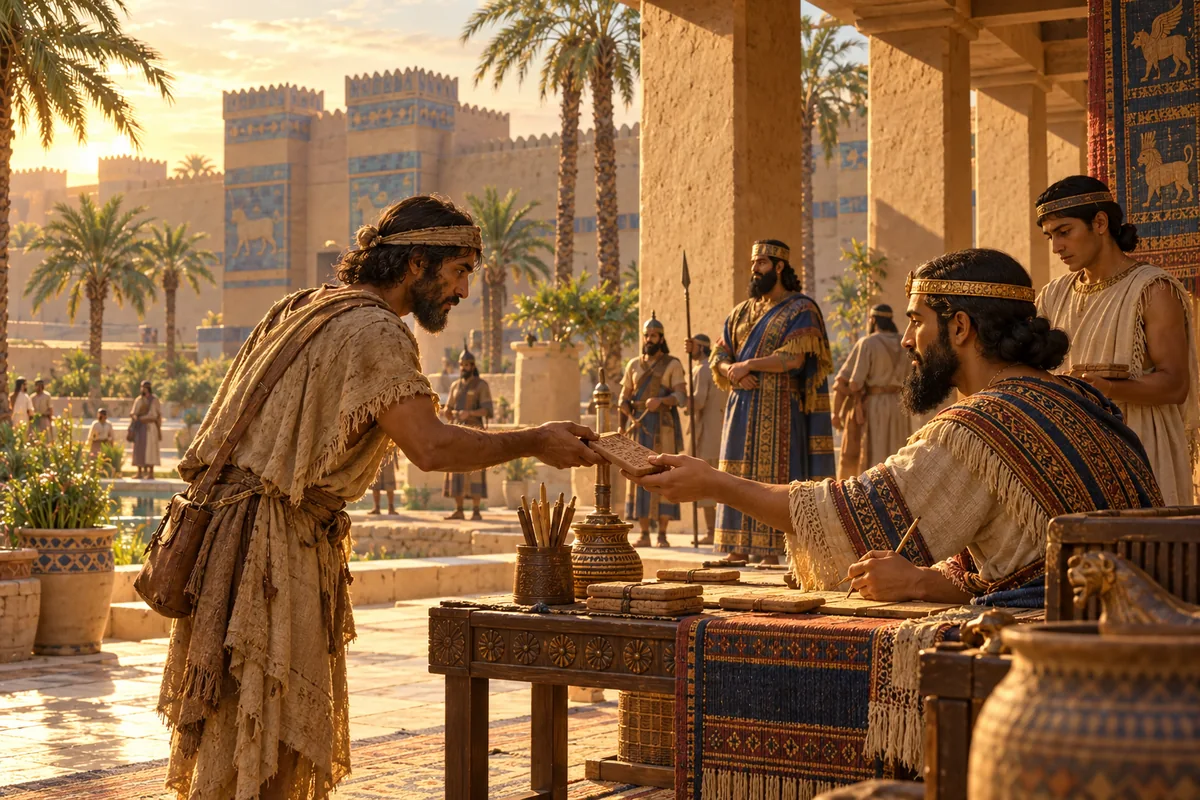
~1300 BCE · Reconstructed composite — see ORACC entry for manuscript witnesses
Šamši-Adad IV 2
“(1) [Šamšī]-Adad (IV), strong king, [king of the world, king of Assyria ...], chosen of the gods Aššur and [Šamaš, ...] beloved of the gods, [...], his [lords]; son of Tiglath-pileser (I) [...]. (5) [The ... of the goddess Išta]r of Nineveh, my lady, which [... had previously restored] had again become dilapidated and [... rebuilt it and again] it had become dilapidated. Now its terrace [...] I built anew (and) finished (it) [...] ... [...]”
Source: Royal Inscriptions of Assyria online (RIAo), Munich Open-access Cuneiform Corpus Initiative (MOCCI), Ludwig-Maximilians-Universität München; in association with the RINAP Project, University of Pennsylvania. https://oracc.museum.upenn.edu/riao/Q006002/
Read the full tablet entry~1300 BCE · Reconstructed composite — see ORACC entry for manuscript witnesses
Šamši-Adad IV 3
Dedicates a restored shrine to Ištar and threatens divine destruction of any future king who neglects it — an early Assyrian formula binding successors to temple maintenance under penalty of dynastic annihilation.
“(1') [...] ... [... had become] dilapidated. Two (monumental) lions on right and left [...] (3') [When the ...] of the goddess Ištar, my lady, becomes old and [dilapidated], may [a future ruler] restore it. (5') [As for the one who does not restore it], may [(the god) Aššur and the goddess Ištar] overthrow [his kingship and make] his name and [his] seed [disappear from his land]. (6'b) [Month ..., ...th day, eponymy of Š]amšī-Adad (IV), king of Assyria.”
Source: Royal Inscriptions of Assyria online (RIAo), Munich Open-access Cuneiform Corpus Initiative (MOCCI), Ludwig-Maximilians-Universität München; in association with the RINAP Project, University of Pennsylvania. https://oracc.museum.upenn.edu/riao/Q006003/
Read the full tablet entry~1300 BCE · Reconstructed composite — see ORACC entry for manuscript witnesses
Šamši-Adad IV 4
“(1) To (the god) Aššur, [his] lord, [...]: (2) Šamšī-Adad (IV), appointee of [the god Enlil, vice-regent of (the god) Aššur], son of Tiglath-pile[ser (I), appointee of the god Enlil, vice-regent of (the god) Aššur], son of Aššur-rēša-i[ši (I), (who was) also appointee of the god Enlil and vice-regent of (the god) Aššur], dedicated (this) long pestle [...] for his life, the well-being of [his] seed, [...]. Whither purification [...]. (8) [If someone] takes (it) either to (another) temple, or [to ...], or to a storehouse, [or to ... and does not return it] to its place [...]”
Source: Royal Inscriptions of Assyria online (RIAo), Munich Open-access Cuneiform Corpus Initiative (MOCCI), Ludwig-Maximilians-Universität München; in association with the RINAP Project, University of Pennsylvania. https://oracc.museum.upenn.edu/riao/Q006004/
Read the full tablet entry~1300 BCE · Reconstructed composite — see ORACC entry for manuscript witnesses
Šamši-Adad IV 5
“(1) Monument of Šamšī-Adad (IV), king of Assyria, son of Tiglath-pileser (I), (who was) also king of Assyria.”
Source: Royal Inscriptions of Assyria online (RIAo), Munich Open-access Cuneiform Corpus Initiative (MOCCI), Ludwig-Maximilians-Universität München; in association with the RINAP Project, University of Pennsylvania. https://oracc.museum.upenn.edu/riao/Q006005/
Read the full tablet entry~1300 BCE · Reconstructed composite — see ORACC entry for manuscript witnesses
Shalmaneser II 1
“(1) Monument of Shalmaneser (II), great king, king of the world, king of Assyria, son of Ashurnasirpal (I), king of Assyria, son of Šamšī-Adad (IV), (who was) also king of Assyria.”
Source: Royal Inscriptions of Assyria online (RIAo), Munich Open-access Cuneiform Corpus Initiative (MOCCI), Ludwig-Maximilians-Universität München; in association with the RINAP Project, University of Pennsylvania. https://oracc.museum.upenn.edu/riao/Q006008/
Read the full tablet entry